
The sub-3 marathon is no longer quite the exclusive club it was five or six years ago, or even earlier.
Advances in equipment, better running shoes, access to information and training resources, and the growing popularity of running have all contributed to an increasing number of recreational runners being able to complete a marathon in under three hours.
However, the fact that sub-3 has become more accessible doesn’t mean it has become easy. For a large number of runners, a sub-3 marathon remains a highly respectable challenge. As the running community grows, so does the number of people setting this as their goal. I am referring here to runners for whom sub-3 is close to their current potential, rather than those for whom it might represent little more than a slow long run, given their ability.
In this article, I look at some of the mistakes and pitfalls I have noticed in my own training and in that of other runners, mistakes that can sabotage your journey towards a sub-3 marathon.
The Reality Check of Marathon Training
To break three hours, you need to cover 42.2 kilometres at an average pace of approximately 4:16 per kilometre, with 4:14–4:15/km being a more sensible target to allow for the realities of racing. This requires much more than being in good shape over 5K or 10K.
This is where many runners go wrong. They focus too heavily on their potential over shorter distances. Yet the abundance of shorter races available to us can sometimes prevent us from training properly for the marathon. Constantly jumping from one race to another leaves little room for a dedicated, structured training block. The marathon is not a distance that rewards training on guesswork or simply running according to how you feel, hoping that a good result over 42.2 kilometres will eventually happen.
It won’t.
Forget the habits that work for distances between 5K and the half marathon if you want to get anywhere near your sub-3 goal. If your only objective is to finish a marathon, you can approach things differently, although a structured preparation is still advisable.
When Race Equivalency Predictions Mislead You
You can find various race equivalency calculators online, including Riegel’s formula and Jack Daniels’ VDOT system, similar to the one shown in the accompanying image.
But equivalency predictions are just numbers on paper. They depend on many factors, including an individual’s physiological potential, training background, running economy and marathon-specific preparation. They represent statistical averages, not guarantees.
A runner with a half marathon time of 1:23 is not necessarily capable of running a sub-3 marathon. Another runner with a 1:26 half marathon might be able to do it. A shorter-distance result tells us something about what a runner might be capable of achieving. Their marathon preparation determines how close they can get to that potential.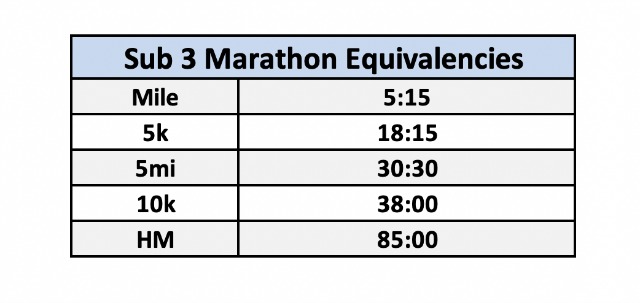
Mileage
There is no magic weekly mileage that guarantees a sub-3 marathon. However, if breaking three hours is close to the limit of your current ability, it is important to establish the highest weekly mileage you can sustain consistently over an extended period.
Unplanned weeks with reduced mileage will affect your entire training build-up. Trying to make up for missed mileage with harder sessions will not solve the problem, even if those sessions provide a temporary confidence boost. A good marathon performance is built primarily on a strong aerobic base, which enables you to handle higher training intensities while recovering adequately.

Strava Ambitions
One of the traps for ambitious recreational runners is the need to prove their sub-3 readiness in every training session. Another is running easy sessions too fast. Easy runs often end up being too demanding because, at first, the pace feels almost too comfortable. But fatigue gradually accumulates. You need to look at the bigger picture, rather than focusing only on the next week or the next couple of weeks.
The purpose of easy runs is to accumulate mileage while finishing with the feeling that you will be adequately recovered for your next quality session. Not every run needs to prove anything.
“That Was a Great Workout”
A sub-3 marathon is not built on one outstanding training session. There is no single workout that can tell you whether you are ready to break three hours.
Just as race equivalency predictions are only statistical estimates, the same applies to Yasso 800s, long runs and specific interval sessions that someone tells you must contain a particular number of repetitions at a particular pace. For example, running kilometre repetitions at 3:35–3:40/km can be an excellent workout. But that session alone does not prove you can maintain 4:15/km throughout a marathon.
Marathon training is a complete process that must be assessed over a much longer period, with all the pieces fitting together. Consistent, high-quality training built around a clear plan and objective over an extended period is where many runners fall short.
Not Enough Long Runs
Long runs develop a type of endurance that is difficult to replicate through other sessions: the ability to keep your body working under sustained physical stress. Runners who regularly complete long runs have the opportunity to experience what happens when their legs become tired, their running form starts to deteriorate and maintaining pace becomes increasingly difficult. Long runs also help the body become better at using fat as an energy source, potentially sparing some of the glycogen stores that are limited and cannot sustain marathon running on their own. They provide an opportunity to test nutrition, hydration, equipment and pacing strategies under realistic conditions.
There are different schools of thought regarding how long these sessions should be. Personally, I do not believe that long runs of just 28–32 km are sufficient if you want to maximise your marathon potential. Nor do I believe that running every long run at an easy pace is enough. Some form of variation at marathon pace needs to be introduced. There are countless ways to approach this, and the right option depends on your training plan and programme.
The key is to prepare specifically for the demands of the marathon rather than simply accumulating distance.
Recovery and Balance
Although most runners struggle more with undertraining than overtraining, some have no problem completing every prescribed session but struggle to recover adequately while balancing training with everyday responsibilities. This can push them in the opposite direction, towards overtraining. Without an appropriate balance of rest, nutrition and overall recovery, performance will suffer.
Finding the right balance between pushing towards peak fitness and crossing the line into excessive fatigue can be a major challenge. More training is not automatically better. The goal is to absorb the training, not merely complete it.
Poor Race Pacing
Even a well-prepared runner can ruin their sub-3 attempt by trying to bank time in the first 10 kilometres. At the beginning of a marathon, the aim should be to keep the effort controlled for as long as possible. Starting conservatively can help manage early energy expenditure and reduce the risk of paying for an overly aggressive opening later in the race.
For example, a sensible strategy is to run the first 5K a few seconds per kilometre slower than your target pace, around 4:16–4:17/km rather than 4:14/km. Starting at your planned marathon pace and aiming for an even split is also a good option, but starting faster than target pace is rarely a smart strategy. You need to preserve your energy while continuing to replenish it through appropriate fuelling during the race.

My Experience
Since I started running in 2013, the marathon has always fascinated me. Initially, my goal was simply to finish one, which I first achieved in 2015. When I ran 3:18 in Zagreb (Croatia) in October 2016, I began to believe that breaking three hours might be possible.
After running a marathon with a negative split, you can sometimes come away feeling that you have much more to give. But improving your time by just a few minutes requires a considerable amount of work. The race equivalency predictions were encouraging when I ran a half marathon in 1:24 in Split (Croatia) in February 2017. However, it still took a great deal of time, effort and several marathon training build-ups before I finally ran 2:57 in Banja Luka (Bosnia and Herzegovina) in October 2021.
Every subsequent marathon preparation, and every race itself, brought new mistakes, opportunities to refine details, lessons about what worked and a deeper understanding of different approaches to training for the 42.195 km distance. Since then, I have broken the three-hour barrier four more times: Manchester in 2:57, Valencia in 2:55, Frankfurt in 2:57 and Newport in 2:58.
For a runner at my level, aiming for these kinds of times, every successful attempt required a near-perfect, carefully executed training build-up lasting several months. There are no shortcuts. Each cycle requires patience, consistency and attention to detail.
Conclusion
The sub-3 marathon will always remain a highly desirable milestone and a major challenge for many recreational marathon runners. Achieving it requires structured training, sufficient and consistent mileage over an extended period, long runs, marathon-specific sessions, carefully managed intensity, recovery, consistency, nutrition and sensible pacing.
Some aspects, such as running economy, cannot be transformed in a single training cycle. There is also limited room to repeat demanding marathon build-ups throughout the year, perhaps two or three times, depending on the individual and their circumstances. This means the process can take considerably longer than many runners expect. It requires patience, discipline, a willingness to learn and mental strength, alongside the physical work.
That is precisely what makes the challenge so appealing. When success is the result of years of dedicated work, the satisfaction of achieving the goal becomes even greater.
Want to run your best marathon?
If your goal is to improve your marathon performance, discover more about my coaching approach and services via the link, or get in touch directly at: info@sub3pt.com.
Pace Up Your Health!