At our Run Club, we’ve already seen beginners feel discomfort, even on our very short 3.5 km route. This is completely normal for people coming from a sedentary lifestyle.
This all happened to me personally. I’m writing from experience after battling injuries for two years while I was running only 20 – 30 km per week. As an experienced runner now, my average weekly mileage is 90 – 100 km, and I am injury-free.
Running looks simple, but it isn’t easy. Each step is a mini-jump that puts force on your bones, ligaments, and tendons. If your body isn’t yet strong enough, small strains can quickly become pain.
Adapting to running takes time and patience. The good news? Most beginner injuries are preventable with smart progression, basic strength, and recovery habits.
The 3 Main Causes of Running Injuries
Load Spikes – Doing Too Much Too Soon
Beginners often try to run too far or too fast at the start. Your lungs might feel ready, but your muscles, tendons, and joints need more time to adapt. Signs of a load spike: 1. Soreness that doesn’t improve after a run; 2. Pain in knees, shins, or ankles, 3. Swelling or stiffness.
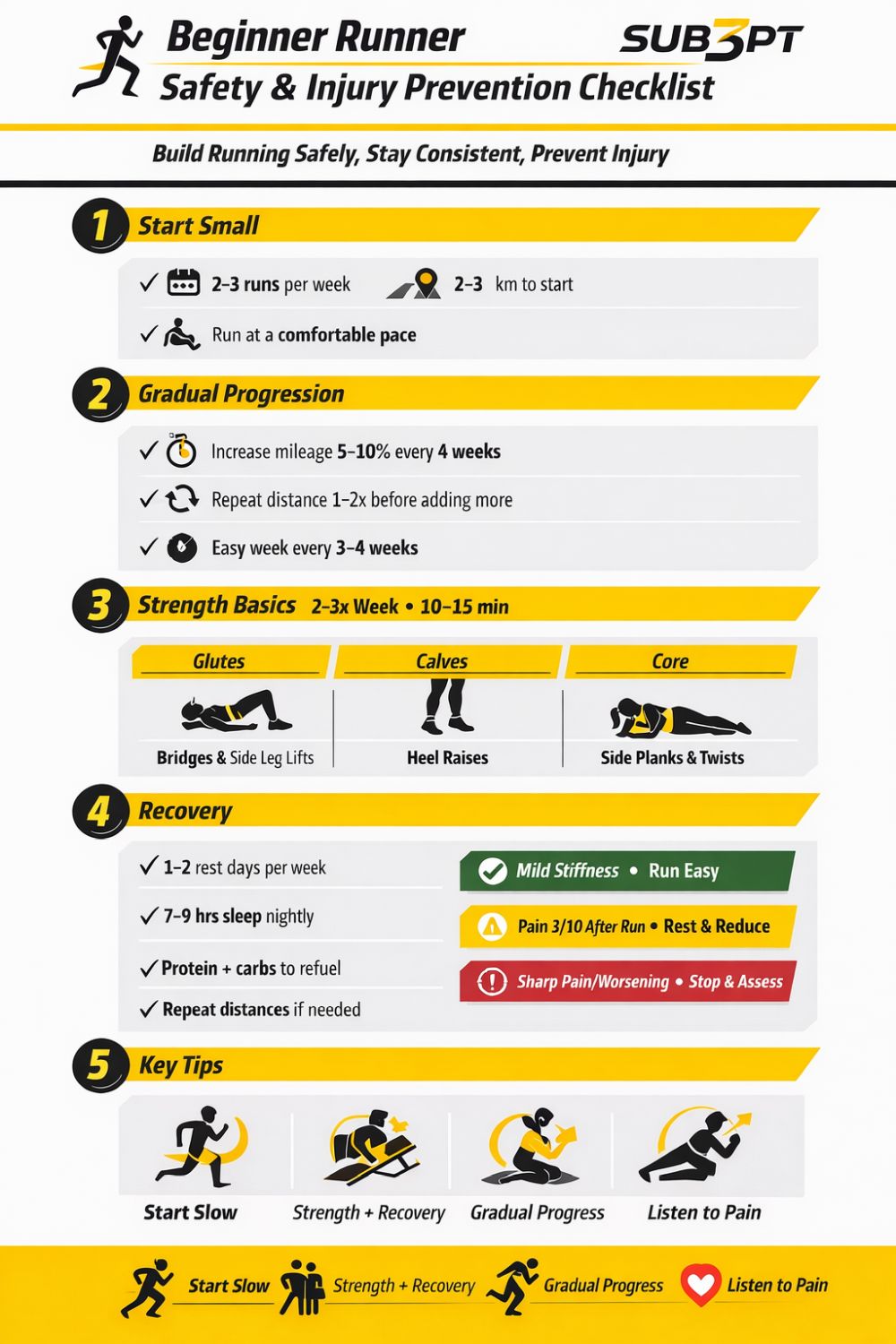
How to prevent it: 2. Start with short distances (2 – 3 km if needed); 2. Increase weekly mileage by no more than 5–10% every 4 weeks; 3. Repeat each new distance 1 – 2 times before adding more.
Weak Links – Your Body Needs Strength Too
Running relies on muscles to absorb impact and maintain good form. Weak hips, calves, or core muscles increase injury risk.
Easy beginner exercises (Glutes): Bridges, side-lying leg lifts; (Calves): Heel raises, (Core): Side planks, gentle twists. Even 10 – 15 minutes, 2 – 3 times per week, helps your body handle running forces better.
Poor Recovery – Rest is Part of Training
Beginners sometimes skip rest days or underestimate the importance of sleep and nutrition. Over time, this leads to soreness, fatigue, and injury.
Tips for recovery: 1. Take at least 1 – 2 full rest or easy days per week; 2. Sleep 7 – 9 hours per night; 3. Eat enough protein and carbs to support training
Smart Load Management for Beginners
Progress Slowly and Consistently
Follow a gradual plan: run 3 times per week at first. Increase weekly distance by a small amount every 4 weeks. Most of your runs should feel comfortable and conversational. Speed will come naturally as your body adapts.
Listen to Your Body
Mild stiffness is normal. Sharp or worsening pain is a warning – stop or reduce intensity. Adjust based on how your body feels, not on a set schedule.
Running is simple, but your body needs time to adjust. With small, steady steps, you’ll stay injury-free and enjoy the process. Soon, those 3.5 km runs will feel easy – and you’ll be ready for longer distances without setbacks.